
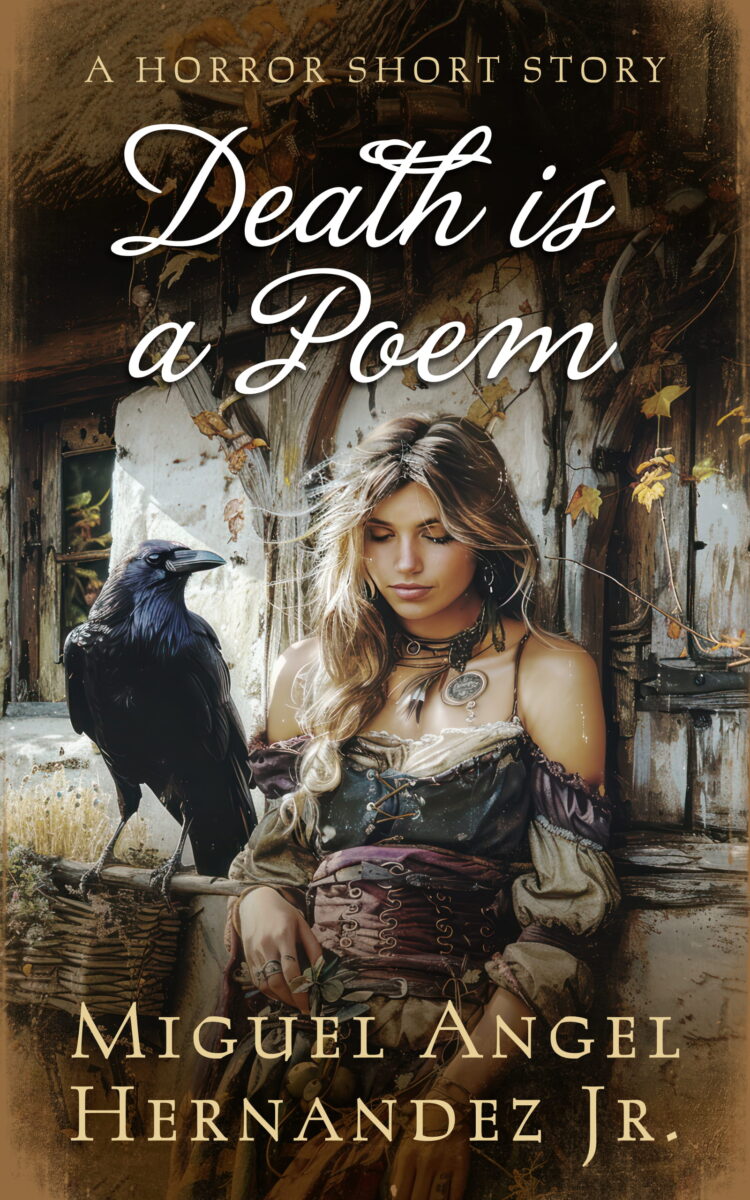
A deep dive into the supernatural horror short story by Miguel Angel Hernandez Jr.
There is a particular kind of dread that does not announce itself. It does not slam doors or shatter windows. It settles — slowly, like fog drifting beneath a door — until the room you have always known feels like somewhere else entirely. That is the dread at the heart of Death Is a Poem, a supernatural horror short story that moves the way a held breath moves: with terrible, patient weight.
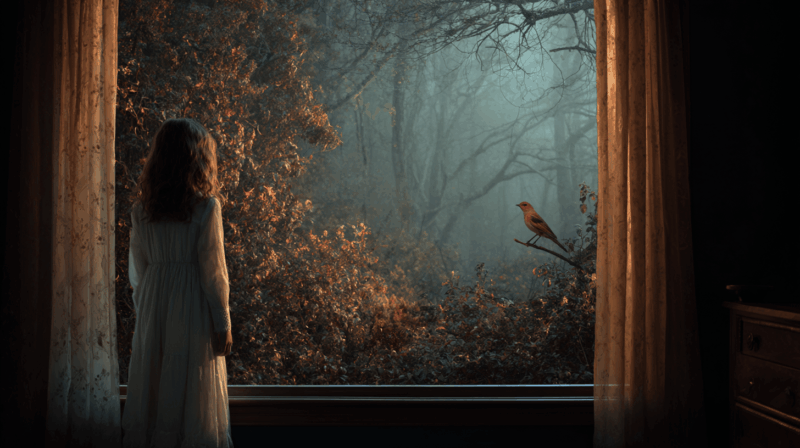
Picture a little girl at her bedroom window. The yard below her is swallowed by overgrowth — wild, unruly greenery creeping too close to the house, too dense for the season, as though the land itself is reaching inward. Emily watches it the way children watch things they cannot name, with wide-open curiosity rather than fear. And then, out of the tangle of branches, a bird appears. Strange. Still. Watching her back.
In that single image, the story reveals its soul: a collision between childhood wonder and something ancient, patient, and hungry. This is gothic mystery fiction at its most intimate — no sprawling haunted mansions, no theatrical covens. Just a family, a pendant, a bird at the tree line, and the creeping certainty that the world has always been stranger than anyone dared admit.
The Emotional Core: A Child at the Center of an Old War
What separates Death Is a Poem from other witchcraft horror stories is where the emotional anchor sits: not with the adults scrambling to understand what is happening, but with Emily herself.
Emily is young enough that the supernatural does not frighten her — not at first. Her innocence is not naivety; it is a kind of grace. She reaches toward the unknown the way children reach toward a moth on a windowpane, with open hands and genuine wonder. And that tenderness is precisely what makes the story devastating.
Around her, fear lives in her parents. Her mother feels it first — that maternal tremor of intuition that something is wrong in a way words cannot contain. Her father, Matt, carries a different weight: the weight of history, of things he was told as a boy and tried to forget.
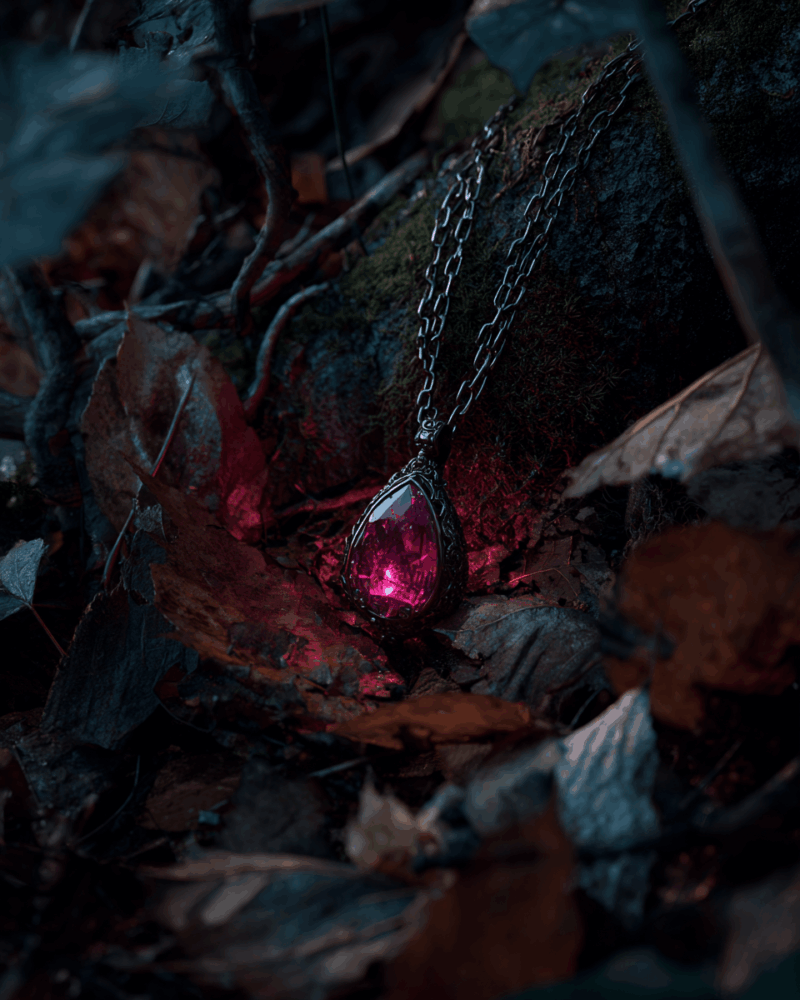
As Emily drifts further into the orbit of whatever has found her, her parents’ fear escalates in counterpoint to her calm. The pendant at the center of the story glows in ways pendants should not glow. Emily moves through the house in states that sit just outside the ordinary. She is present, but present somewhere else too.
This tension — between parental fear and the supernatural pull on a child — gives the story the emotional texture of a tragedy rather than a simple fright. Readers who love character‑driven horror will find here not a monster to fear, but a love to mourn.
The World Behind the Story: Witchcraft, Legacy, and the Liminal Wood
Death Is a Poem belongs to the Standalone Mystery & Thriller Shorts universe — a collection of self-contained stories connected by atmosphere, moral weight, and folkloric darkness. Within that universe, this story functions almost like an origin myth.
The witchcraft mythology draws from Salem-era history without being bound to it. There is reverence for the source material — the trials, the hysteria, the bodies buried in silence — but the story transforms that history into something more primal. The witches here are not simply condemned women. They are figures of terrible power who made terrible promises, and whose promises did not end with their deaths.
Matt’s revelations — delivered haltingly, the way men reveal things they have spent decades refusing to believe — open a window into a mythology more unsettling than any ghost story. There is a buried boy. There is a lineage of consequence. And there is the slow, sickening realization that what is happening to Emily is not random. It was never random. The pendant did not find her. It came back for her.
The overgrowth outside the family home functions as a liminal space — a threshold between the known world and whatever older world presses against its edges. In dark folklore horror, the forest is never just trees. It is a place where rules dissolve, where time folds, where the things that should be dead continue their business. Hernandez uses this overgrowth with restraint: he does not send characters into the woods. He lets the woods come to them.
Themes That Resonate: The Human Heart of the Horror
The Cost of Promises
The most haunting thing about Death Is a Poem is not what the witches are — it is what they were owed. Some promises survive death. Some oaths do not dissolve when the person who made them is gone. They pass forward. They find the next generation.
The Innocence of Children and the Sins of Adults
Emily has done nothing wrong. The darkness that reaches for her was set in motion before she was born. This gives the horror genuine moral weight.
Witchcraft as Legacy
Here, witchcraft is not a spell or a trick. It is a bloodline — something inherited, something that binds.
Fear of the Unknown
Matt’s fear is deeply human: the terror of being unable to protect the people you love from forces you barely understand.
The Fragility of Family
At its core, this is a story about a family under siege — not by violence, but by something older and stranger.
Behind the Story: Inspiration, Influence, and the Gothic Imagination
Every horror story begins in a feeling before it begins in a plot. For Death Is a Poem, that feeling is the moment in childhood when you first understood that the world was not entirely safe — not dangerous in the way of traffic or illness, but dangerous in some older, stranger way your parents could not explain.
The gothic and folkloric influences run deep:
- American supernatural tradition
- Salem’s lingering shadow
- Fairy‑tale logic, where children wander into forests that are always waiting
What is remarkable is the compression. A short story that carries the mythological weight of a novel is difficult to build. Hernandez solves this through restraint. He tells you less than you want to know and more than you can comfortably hold.
Why Death Is a Poem Matters in Horror Right Now
Horror is in a renaissance. Readers want supernatural horror that speaks to human truth — stories that scare the body while unsettling the soul.
Death Is a Poem arrives in that tradition and extends it.
It proves something important:
You do not need a novel’s length to create a world worth inhabiting.
Within the landscape of supernatural horror short stories, it stands out as atmospheric, emotionally honest, and genuinely frightening — a modern entry in the lineage of gothic mystery fiction.
An Invitation
If you’re drawn to dark folklore horror, gothic atmosphere, and stories that linger long after the last line, then you are already the reader this story was written for.
The Standalone Mystery & Thriller Shorts series is exactly what it promises: a collection of self-contained worlds, each carrying the signature of a writer who takes the darkness seriously.
Death Is a Poem is one door into that universe. There are others.
Some promises, after all, are worth keeping.