
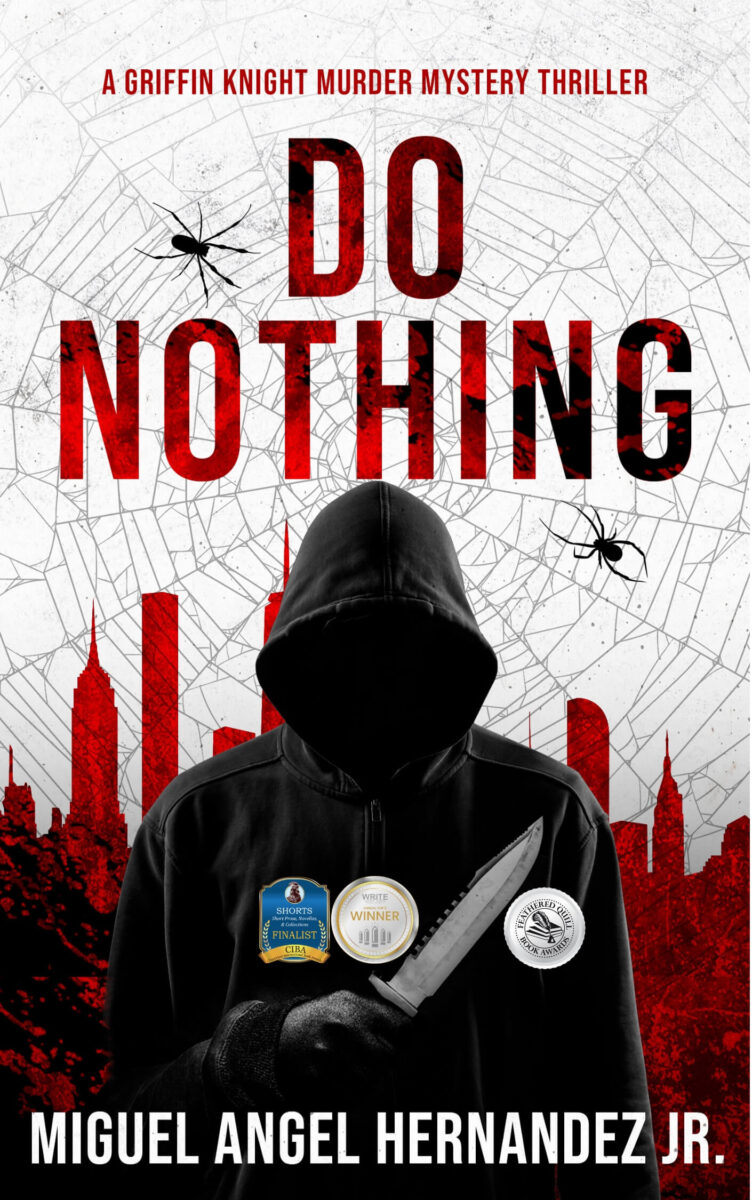
Do Nothing interrogates the fragile line between justice and vengeance as Detective Griffin Knight pursues a serial avenger in New York City. The novel asks what we owe the dead—and ourselves.
At first glance, Do Nothing is a taut crime thriller: a serial killer resurfaces, a city is on edge, and a detective must piece together a terrifying pattern. But beneath that pulse-pounding premise lies the book’s deeper interrogation of moral complexity. Who gets to decide what justice looks like? When institutional systems fail, does vengeance become a form of truth-seeking? Miguel Angel Hernandez Jr. uses the case as a prism to explore these questions through the eyes of Griffin Knight.
Griffin’s investigation forces him to confront uncomfortable truths—about the victims, the neighborhoods they came from, and the small, overlooked injustices that can lead to explosive consequences. The killer in Do Nothing is not portrayed as a cartoon villain; instead, the avenger is rendered as an idea: someone acting on a skewed moral logic, convinced of their own righteousness. This framing raises uneasy parallels to how society sometimes glorifies retaliatory violence when it appears to deliver easy answers.
Another central theme is the weight of memory and trauma. Griffin carries the scars of past cases and personal losses, and those experiences shape his judgments and instincts. The novella explores how trauma can be both a motivator and a blindfold—motivating a detective’s pursuit of the truth while also coloring what he sees. Readers watch him wrestle with instinctual responses and the hard, slow work of evidence-based investigation.
Urban anonymity and the city itself function almost like another character. New York’s textures—the subway’s roar, rain-slick streets, fluorescent-lit precincts—provide a backdrop that amplifies the story’s moral ambiguities. Hernandez Jr. shows how a metropolis can hide patterns in plain sight: the same bus routes, the same late-night corners, the same bureaucratic blind spots. In such a landscape, the difference between justice and vengeance is not always clear-cut.
Ultimately, Do Nothing delivers on suspense while inviting readers to consider what it means to seek closure in a world that resists tidy answers. It’s a story that will stay with you after the final page, not just for its twists, but for the ethical questions it quietly refuses to resolve.
Did you enjoy the world of Do Nothing? Please leave an honest review on Amazon and/or Goodreads.